


The foundations and dimensions of green citizenship

The foundations and dimensions of green citizenship 18 November 2024 To gain a deeper understanding of the contemporary dynamics, discourses, practices, governance practices, and impacts of green citizenship, it is necessary to delve into the conceptual foundations and explore the different meanings associated with this idea. Green citizenship did not emerge ex nihilo, nor does it exist in isolation, but is rooted in and shaped by a complex interplay of pre-existing concepts and practices that have emerged over time. The purpose of this paper is to reflect on these dimensions of meaning and, in the end, to offer a reflection on how they contribute to evolving environmental governance. Through various insights from different authors, we aim to reflect on how environmental or green citizenship can be understood,1 placing the concept of green citizenship in the theoretical framework of eco-governance at the very end of the chapter. Powered By EmbedPress
Challenges of researching young people’s political participation outside the ballot box

Challenges of researching young people’s political: Participation outside the ballot box 18 November 2024 This paper critically examines youth political participation, challenging the pervasive narrative of political apathy among young people in democratic societies. While traditional studies often equate low electoral engagement with disinterest in politics, emerging evidence highlights young people’s preference for alternative and informal forms of political participation. Using examples from Slovenia, such as the referendum on the Water Act Amendment and environmental protests, the study demonstrates how youth-led activities redefine politics through direct action, networks, and civil society initiatives. Drawing on theoretical perspectives and critiques of narrow definitions of political participation, the paper advocates for a broader understanding that includes everyday political actions, both online and offline. By incorporating youth voices and recognizing the interplay between political, social, and private spheres, this research emphasizes the importance of moving beyond binary categorizations of political participation. Ultimately, the study underscores the transformative potential of youth political agency in reshaping democratic practices and fostering dialogue between policymakers and young people. Powered By EmbedPress
Topic 10 – Democracy in the end times: Care as politics

Topic 10 – Democracy in the end times: Care as politics 18 November 2024 Section overviewThis section explores the deep connections between climate change, political instability, and the evolving concept of care as a transformative political and economic force. While traditional climate studies have often emphasized environmental and economic impacts, this chpater shifts focus to the social and political dimensions of the crisis, arguing that the climate emergency threatens not only ecological balance but democratic structures and social cohesion worldwide. Increasingly, populist and authoritarian approaches are emerging as responses to climate-induced crises, highlighting the urgent need for new models of political and social organization.A central theme of the chapter is the re-emergence of care as a vital concept for rethinking political community and social relationships. Drawing from thinkers like David Graeber and Joan Tronto, the section examines care not only as an ethical commitment but as a basis for alternative political economies. Students will investigate how care, once confined to the private sphere or seen as a moral duty, is now envisioned as an inclusive, democratic force that counters neoliberal individualism and advocates for communal responsibility. Graeber’s concept of a “caring politics” and Tronto’s notion of “caring democracy” offer blueprints for a society where mutual aid, solidarity, and egalitarian access to resources replace profit-driven models. Powered By EmbedPress
Topic 7 – Interlude III: Sous les Pavés, la Plage!

Topic 7 – Interlude III: Sous les Pavés, la Plage! 18 November 2024 Section overviewThis chapter investigates the emergence of new forms of citizenship and political community beyond the nation-state framework, focusing on urban spaces as sites of political experimentation and community-building. Traditional models of citizenship have often restricted political participation to the boundaries of the nation-state, where legal and social rights are tightly linked to national identity. However, in an increasingly globalized world, cities have become strategic spaces for fostering non-state political communities, allowing marginalized groups and migrant communities to engage in the political process.Through examples like the Beyond the Construction Site project in Ljubljana, which transformed an abandoned lot into a vibrant community garden, the section highlights how urban projects can serve as laboratories for new forms of citizenship. These spaces can be understood as “exilic spaces,” as they provide platforms for disenfranchised communities to create alternative social, political, and economic structures independent of both state control and capitalist accumulation. Such spaces enable “translocal citizenship,” where political membership transcends national identity and creates inclusive, flexible communities that connect diverse groups. Powered By EmbedPress
Topic 6 – Democracy, state and citizenship

Topic 6 – Democracy, state and citizenship 18 November 2024 Section overviewThis chapter examines the evolving concepts of democracy and citizenship beyond the traditional constraints of the state, exploring the potential for a new, inclusive, and pluralistic form of citizenship. Namely, traditional political science often frames democracy and citizenship within the rigid boundaries of the nation- state, equating citizenship with a static territorial identity. However, global interconnectedness and increasing influence of non-state actors demand a rethinking of these terms.The chapter introduces concepts like “translocal citizenship,” emphasizing forms of political belonging and participation that transcend national boundaries, aligning more closely with the needs of a globalized world. Drawing on Boaventura de Sousa Santos’ idea of “equal differences,” this new citizenship balances equality with the recognition of diverse identities, rejecting universal citizenship models that homogenize individuals. Instead, “new citizenship” is rooted in local, municipal participation, allowing people to engage with their communities while acknowledging global ties. Powered By EmbedPress
Topic 5 – Interlude II: Epistemological and methodological challenges

Topic 5 – Interlude II: Epistemological and methodological challenges 18 November 2024 Section overviewThis section critiques conventional approaches to democracy, emphasizing the need for new frameworks to address biases and limitations in mainstream political science. Traditional methods often reduce democracy to institutional structures or the rule of elites, which ignore grassroots democratic expressions and perpetuate a top-down view. Drawing on Boaventura de Sousa Santos’ notion of “epistemicide,” the section examines how hegemonic views marginalize alternative democratic practices, reinforcing a narrow, economically driven perspective on democracy. Powered By EmbedPress
Topic 4 – Interlude I: Democracy and Jazz

Topic 4 – Interlude I: Democracy and Jazz 18 November 2024 Section overviewThis chapter draws an analogy between democratic practice and the spirit of jazz, exploring how jazz embodies democratic principles through improvisation, collaboration, and spontaneity. It begins by revisiting foundational democratic concepts, highlighting the often-overlooked “vernacular” knowledge or mētis, which reflects a localized, intuitive understanding of democracy in contrast to formalized or theoretical approaches. Jazz, as a form of musical expression rooted in individuality and collective interaction, parallels this democratic mētis, emphasizing participation and adaptability over hierarchy. Powered By EmbedPress
Topic 3 – Democracy or republic?
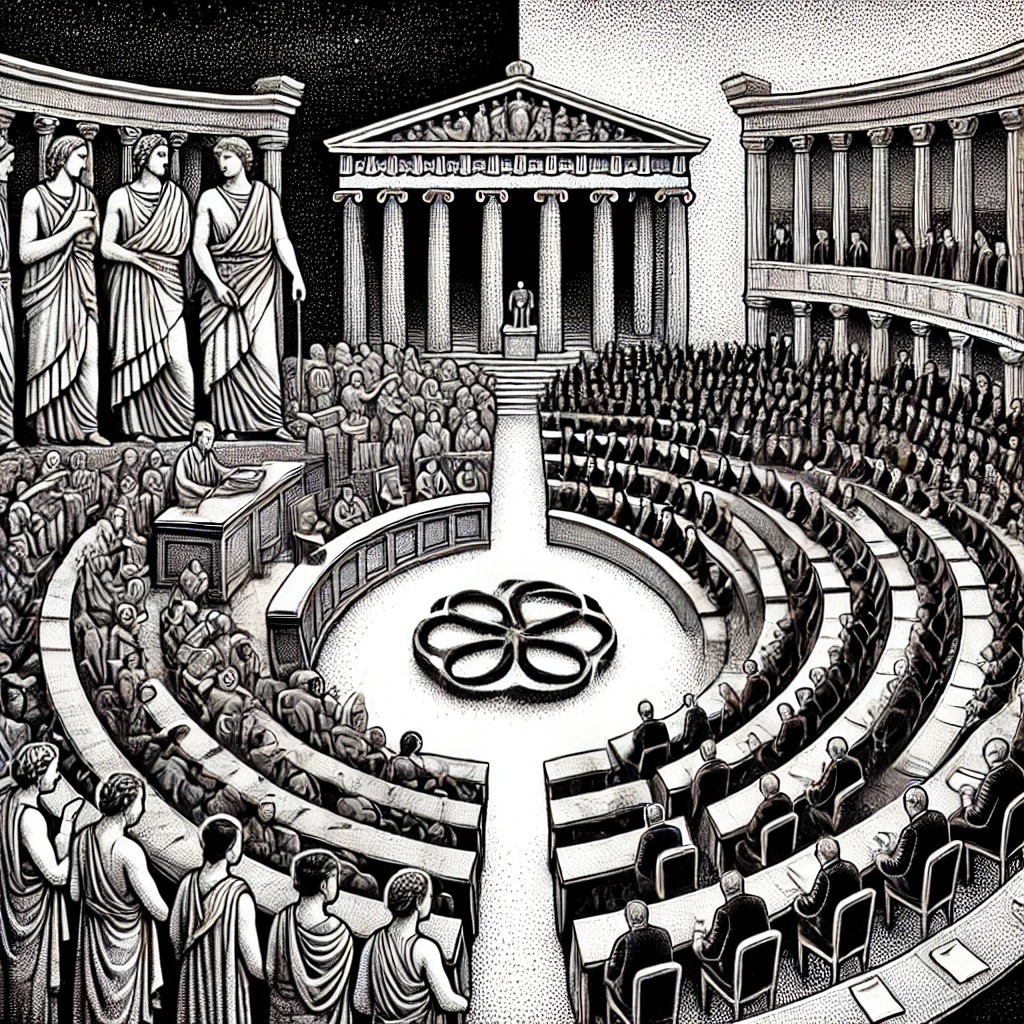
Topic 3 – Democracy or republic? 18 November 2024 Section overviewThis section explores the evolving concept of democracy, addressing its origins, theoretical foundations, and the dissonance between its ideals and practical applications. Central to this inquiry is the notion of “political agoraphobia”—the apprehension that democratic power can destabilize hegemonic structures and empower marginalized groups, threatening the authority of elite institutions (Dupuis-Déri, 2011). The text examines how democracy’s ideals, often rooted in egalitarianism and direct governance by the people, are paradoxically perceived as a risk to stability in Western liberal democracies. This is evidenced in critiques by influential figures such as Michel Crozier, Samuel Huntington, and Joji Watanuki, who argued that an “excess of democracy” can disrupt governance and advised moderation to maintain political control (Crozier et al., 1975). Powered By EmbedPress
Topic 2 – What is democracy?

Topic 2 – What is democracy? 18 November 2024 Section overview This section explores the evolving concept of democracy, addressing its origins, theoretical foundations, and the dissonance between its ideals and practical applications. Central to this inquiry is the notion of “political agoraphobia”—the apprehension that democratic power can destabilize hegemonic structures and empower marginalized groups, threatening the authority of elite institutions (Dupuis-Déri, 2011). The text examines how democracy’s ideals, often rooted in egalitarianism and direct governance by the people, are paradoxically perceived as a risk to stability in Western liberal democracies. This is evidenced in critiques by influential figures such as Michel Crozier, Samuel Huntington, and Joji Watanuki, who argued that an “excess of democracy” can disrupt governance and advised moderation to maintain political control (Crozier et al., 1975). Powered By EmbedPress
Topic 1 – Introduction

Topic 1 – Introduction 18 November 2024 Section overviewWith global warming exacerbating crises in food security, economic stability, and sustainable development, traditional democratic structures are increasingly under strain. This section explores the interplay between climate change and democratic systems, emphasizing the urgent need for transformative thinking in both ecological and political realms. It argues that addressing climate change requires more than technological fixes; it demands deep social, political, and epistemological shifts, particularly given the democratic backsliding and rise of authoritarian responses to crises. Powered By EmbedPress